Lesson one
Collective creativity
Given the tools and a chance, strangers made paintings that were funny, playful and full of ideas. Together they had more creativity than one person alone.
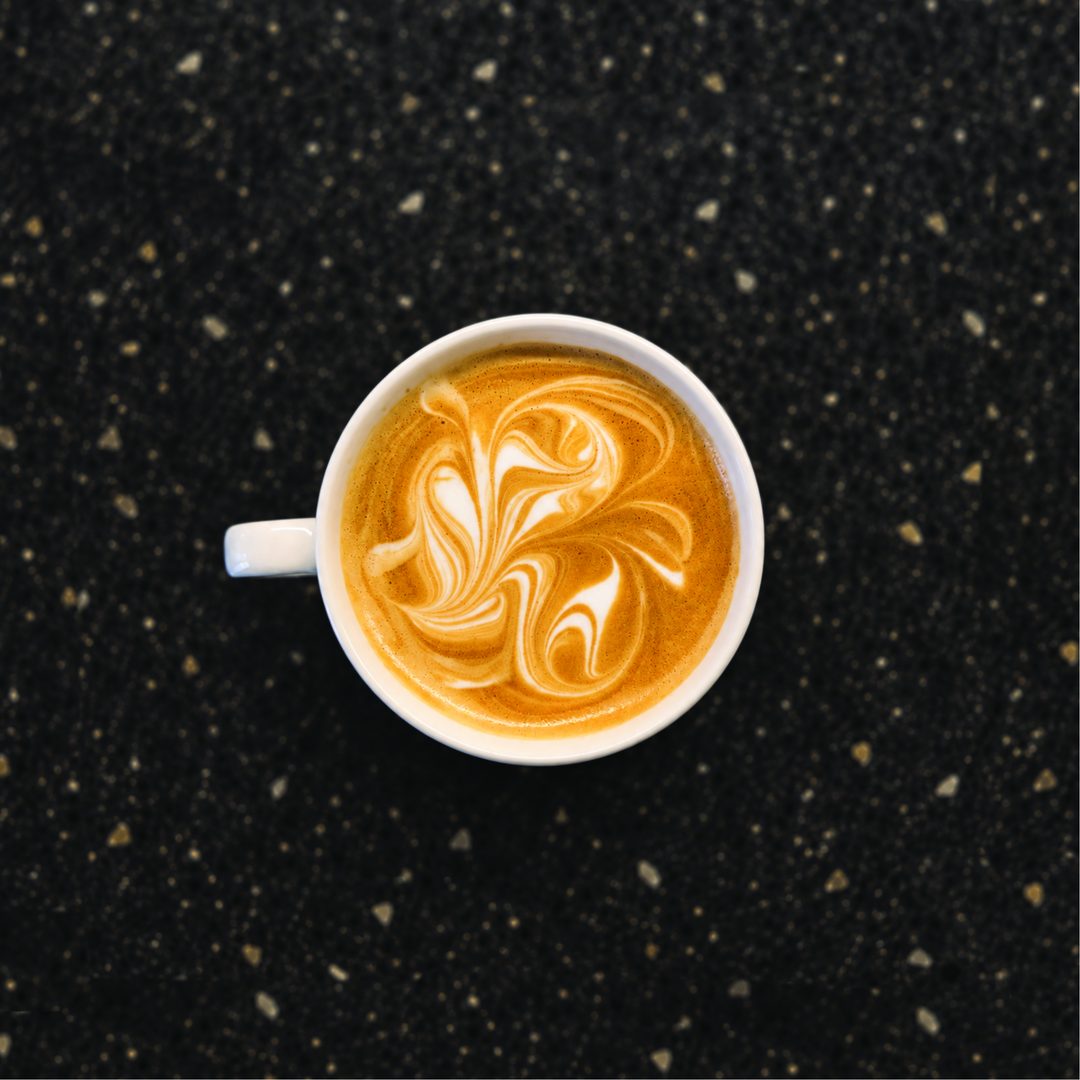
Every morning I try to pour latte art, and fail. With a teaspoon, I turn the coffee failing into a coffee painting. Then I photograph it, and drink it.
Nothing is added to the cup. The same foam that refused to become a heart or a tulip is pushed and pulled until something unplanned appears. It lasts a few seconds. The photograph is the only evidence.
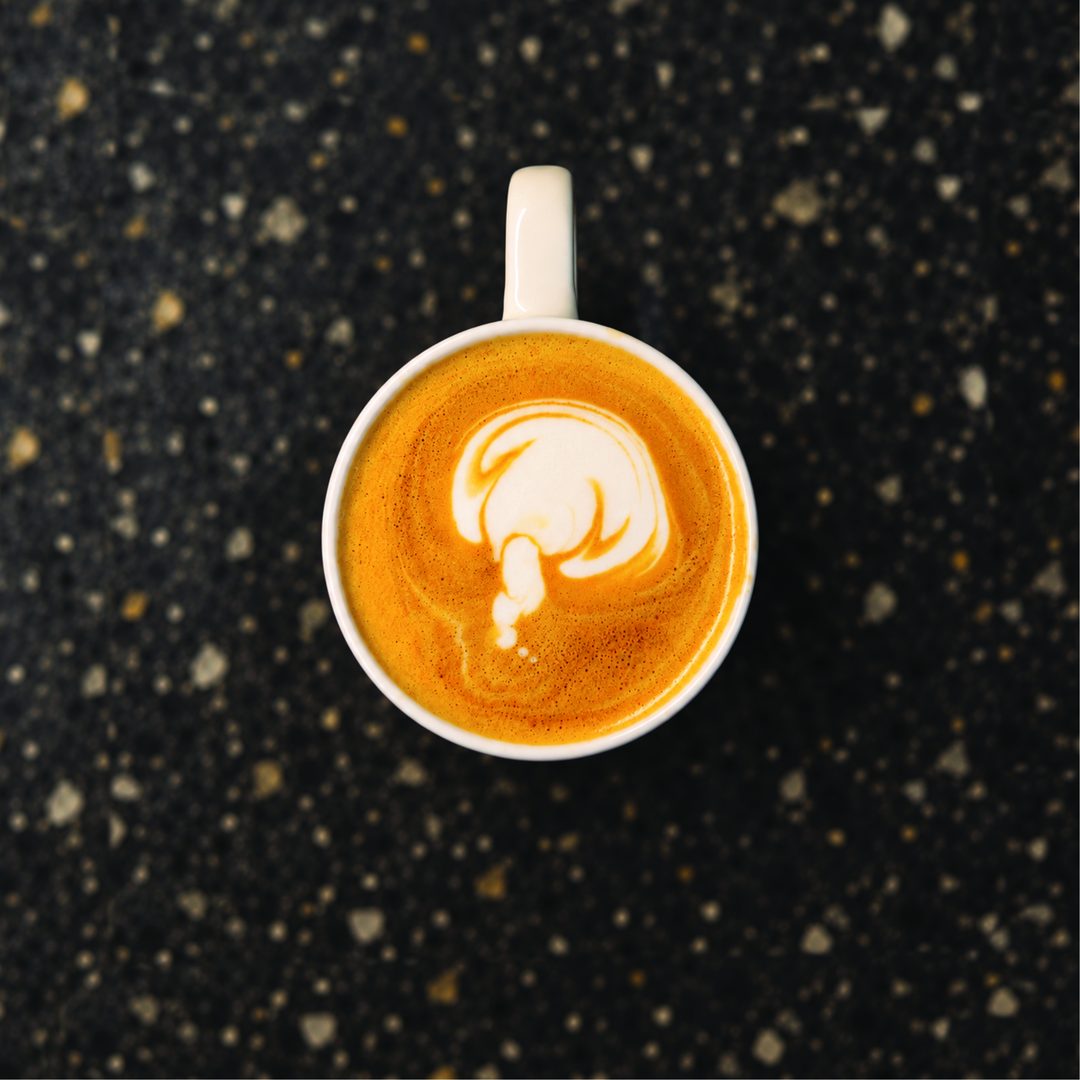
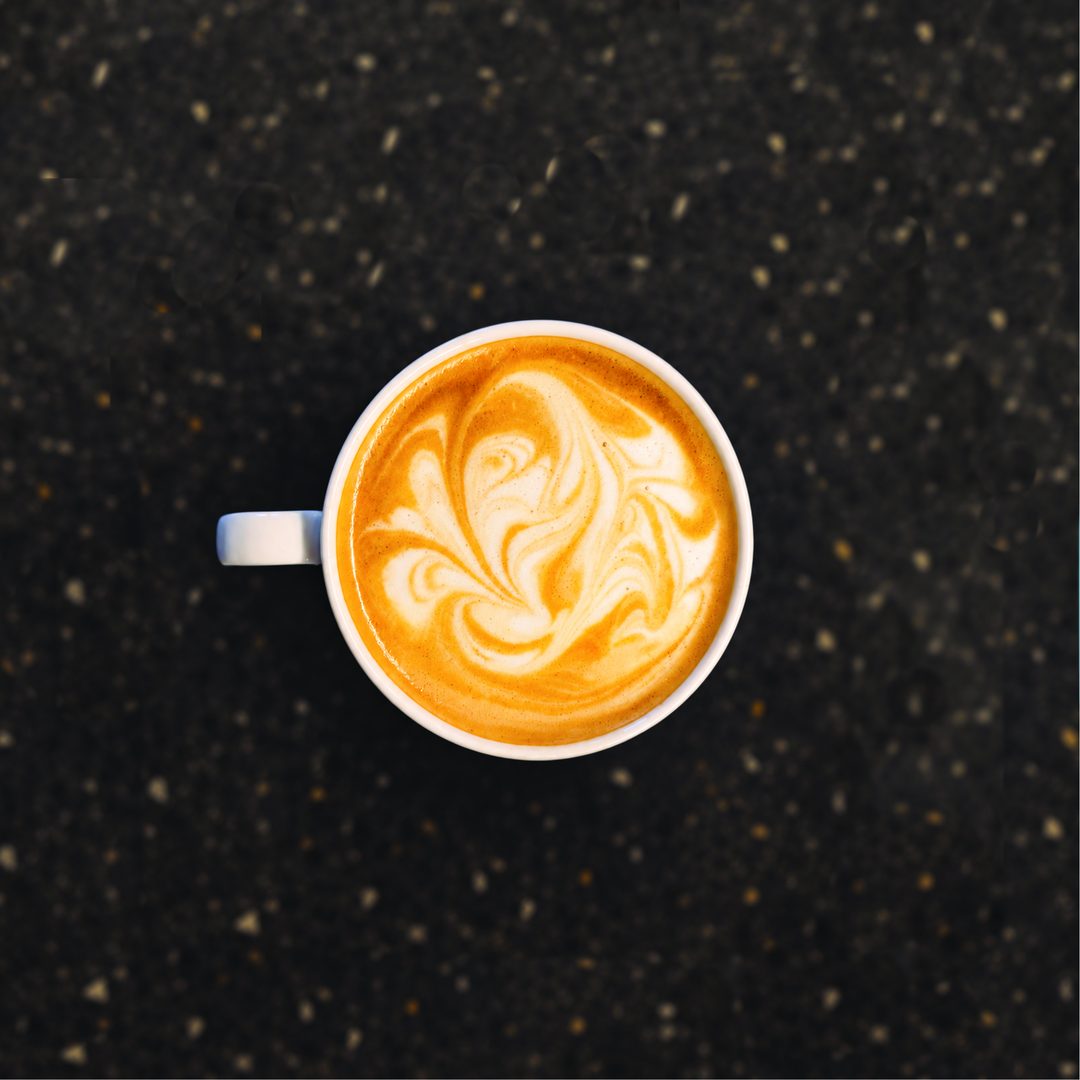
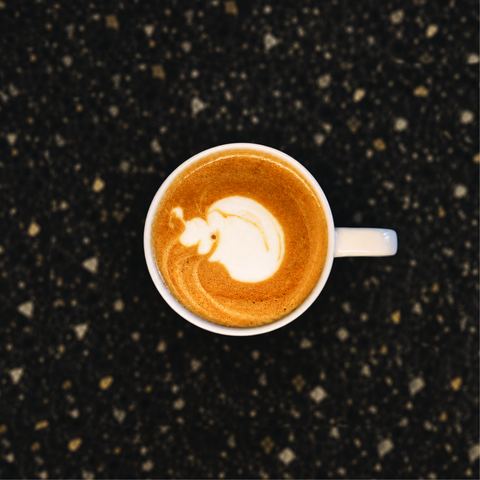
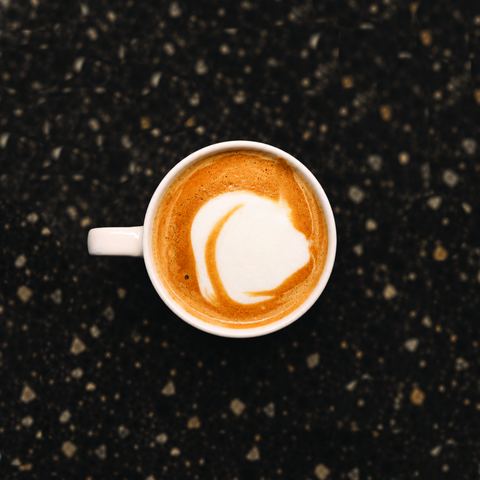
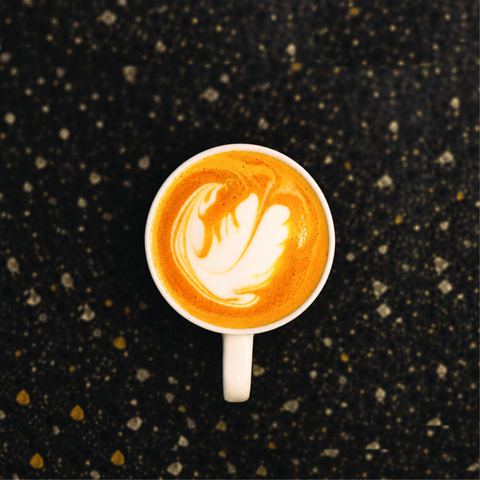
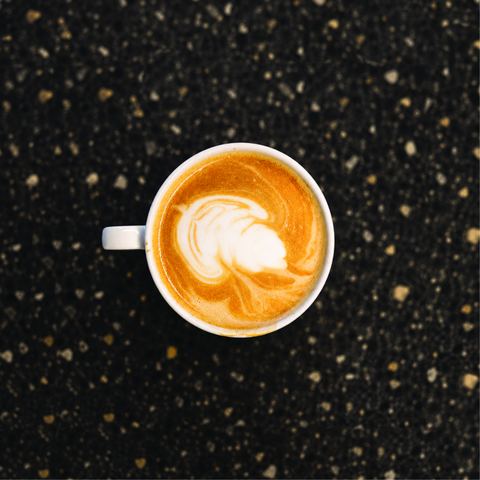
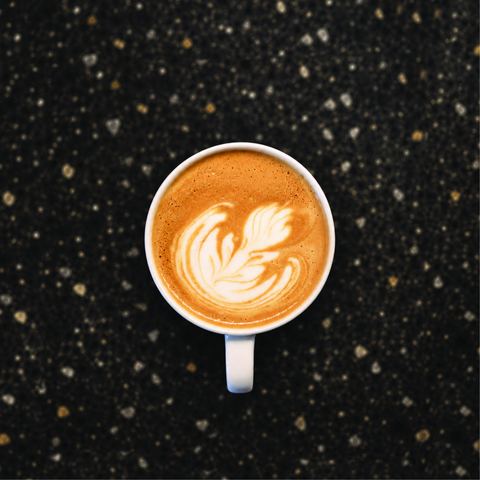
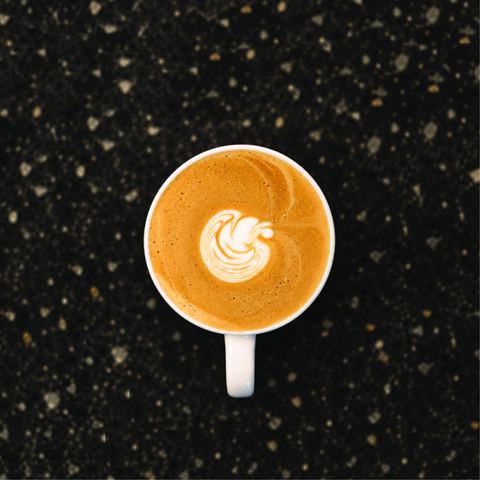
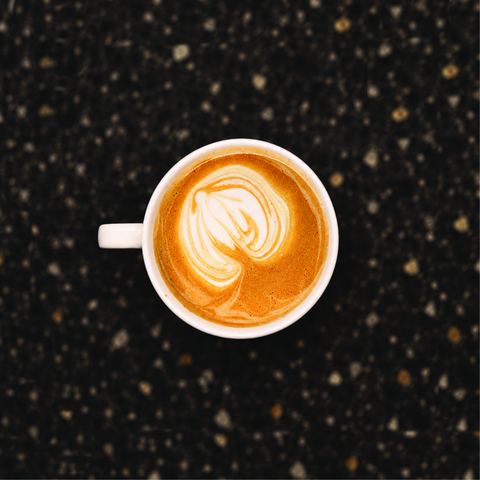
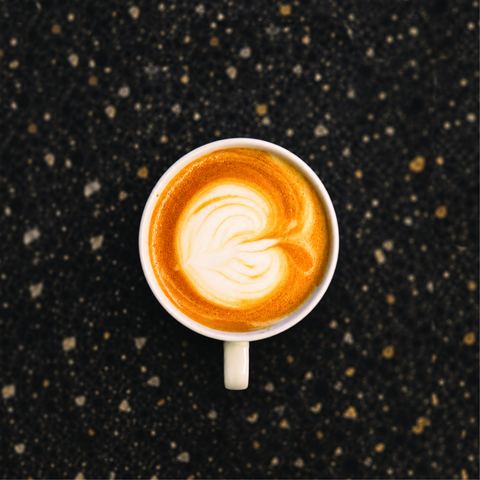
Real pours that missed, shown beside the paintings. Each one is a starting point, not a mistake to hide.
Every day, I make myself a coffee. I try to pour latte art, and every day, I fail. Instead of discarding the attempt, I take a teaspoon and play with the milk foam, turning a daily mistake into a little artwork. I call them my ‘coffee failings’ turned ‘coffee paintings’.
The title ‘One: At a Time’ serves as both a creative method and a mental anchor. When navigating the extremes of bipolarity, whether pulled in endless, scattered directions by an ‘up’ or lost in the paralyzing zero of a ‘down’, the concept of ‘one’ becomes a lifeline. One focus. One step. One stroke of a teaspoon. When we cannot access the whole of ourselves, doing just one humble act is the most grounding thing we can do. It gently tames the chaos and lifts the fog.
This exhibition celebrates that ordinary ‘one’. On display are forty of these daily interventions, small cups capturing moments where mistakes were transformed through curiosity. Through an interactive digital canvas, I invite you to join me. You can take a raw ‘coffee failing’ and trace your own path to a painting, receiving the result as a reminder: health, life and balance aren’t built on grand gestures, but on small acts, taken one at a time.
Elke dag zet ik een kop koffie. Ik probeer latte art te maken, maar elke dag mislukt het. In plaats van de poging weg te gooien, speel ik met een theelepeltje in het melkschuim en maak ik van een dagelijkse fout een kunstwerkje. Ik noem ze mijn ‘koffiemislukkingen’, omgetoverd tot ‘koffieschilderijtjes’.
De titel ‘One: At a Time’ is zowel een creatieve methode als een mentaal anker. In de uitersten van bipolariteit, of je nu eindeloos alle kanten op wordt getrokken in een ‘up’ of verloren raakt in de verlammende nul van een ‘down’, wordt het idee van ‘één’ een reddingslijn. Eén focus. Eén stap. Eén streek met een theelepeltje. Als we geen toegang hebben tot ons volledige zelf, is één bescheiden handeling wat ons het meeste houvast geeft. Het verzacht de chaos en doet de mist optrekken.
Deze tentoonstelling viert die gewone ‘één’ met veertig van deze dagelijkse ingrepen, kleine kopjes die momenten vastleggen waarin vergissingen door nieuwsgierigheid worden getransformeerd. Via een interactief digitaal canvas nodig ik je uit om mee te doen. Neem een ruwe ‘koffiemislukking’, zoek je eigen weg naar een kunstwerk en ontvang het resultaat als herinnering: gezondheid, leven en balans bouw je niet met grote gebaren, maar met kleine handelingen, één voor één.
Hung as one field on black foam board, the way they were made: one a day, none more important than the others. Switch to blue to see them as the station’s gallery showed them, the colour that came from a misprint.
Half a day in the foyer of the Ups & Downs Forum, among cocktail tables and other artists’ work. The phone photos are printed in the exhibition’s blue, the same way the gallery showed the visitors’ paintings.
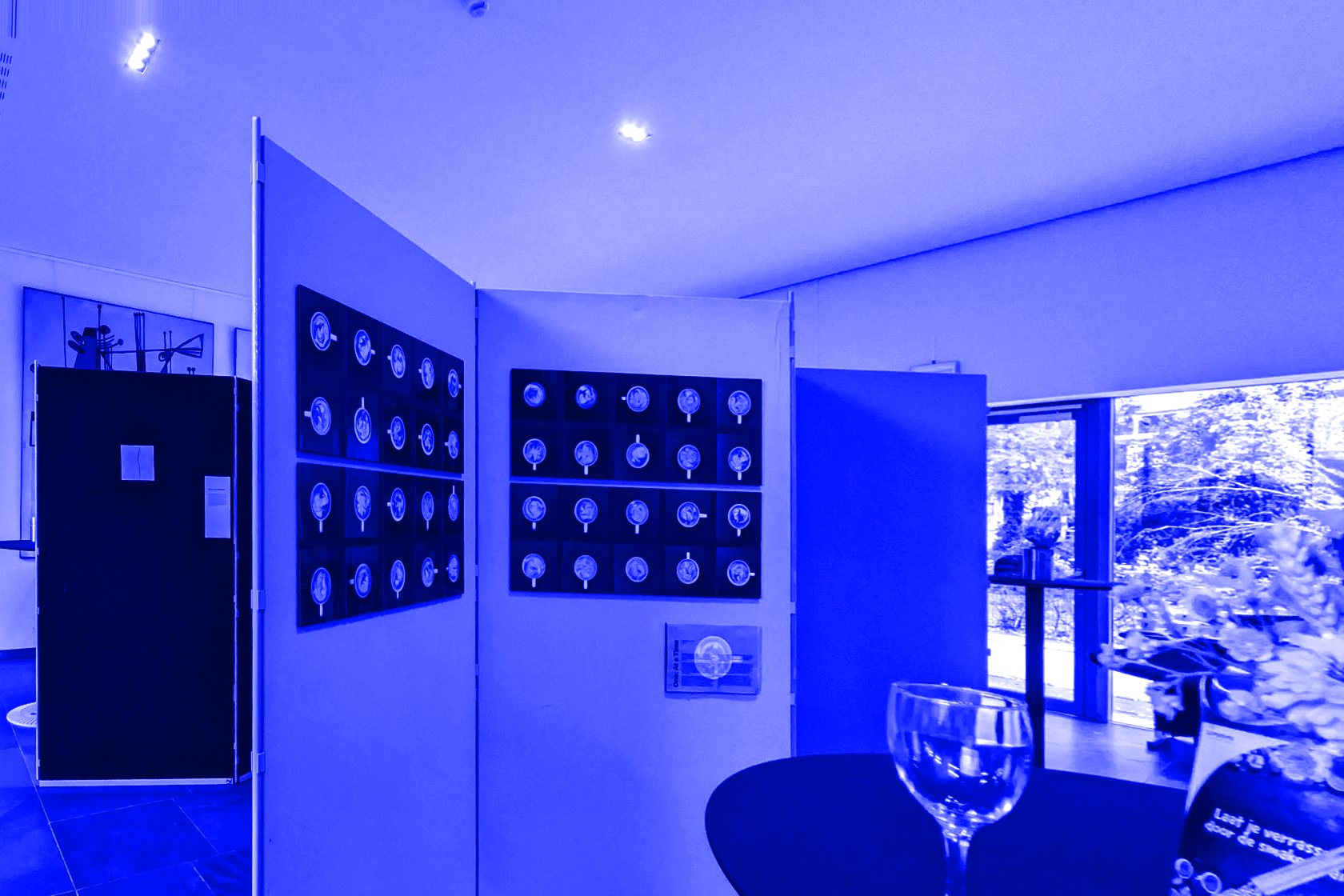
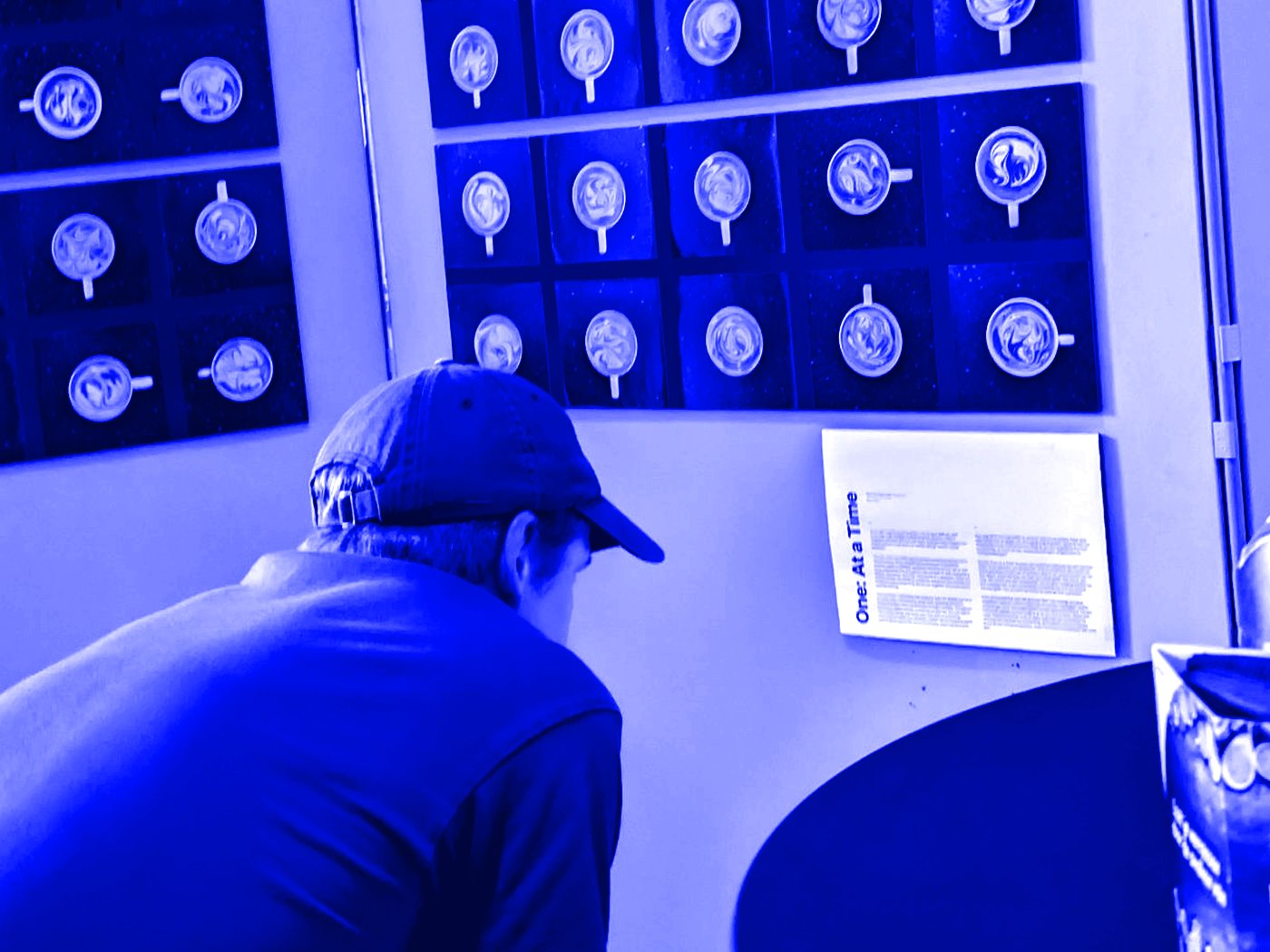
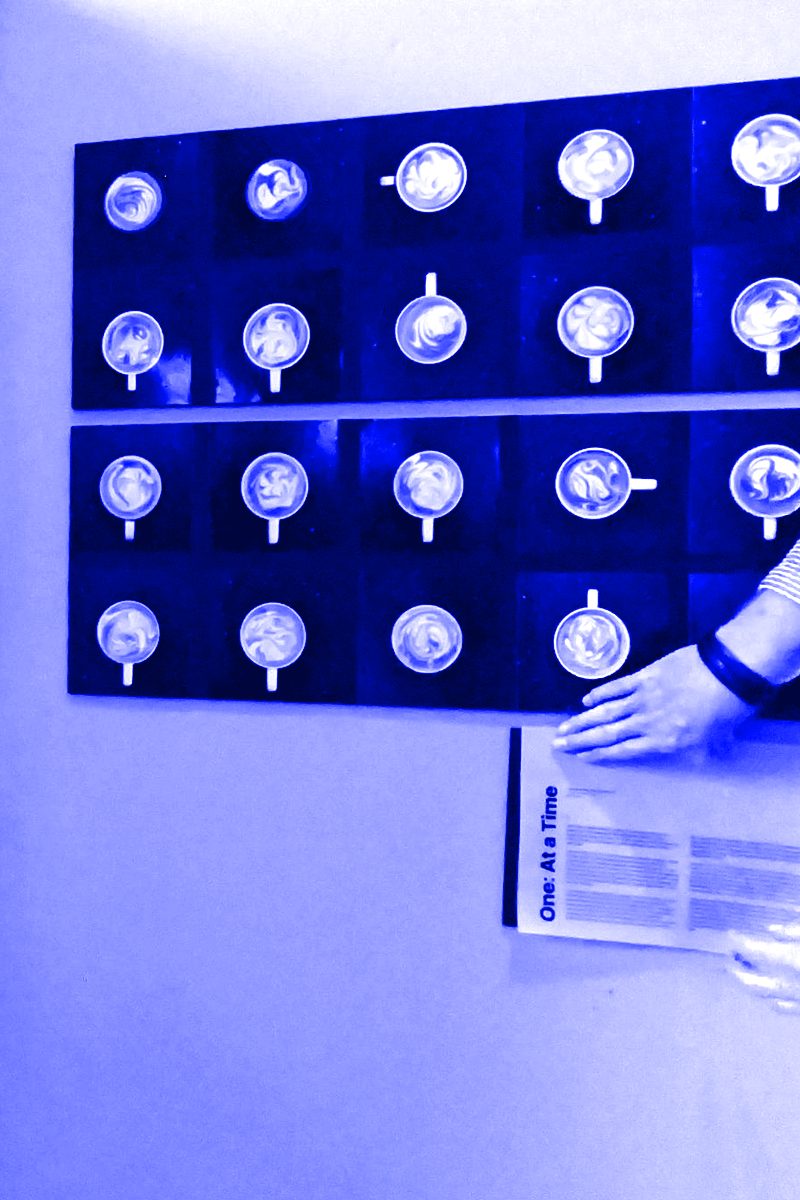
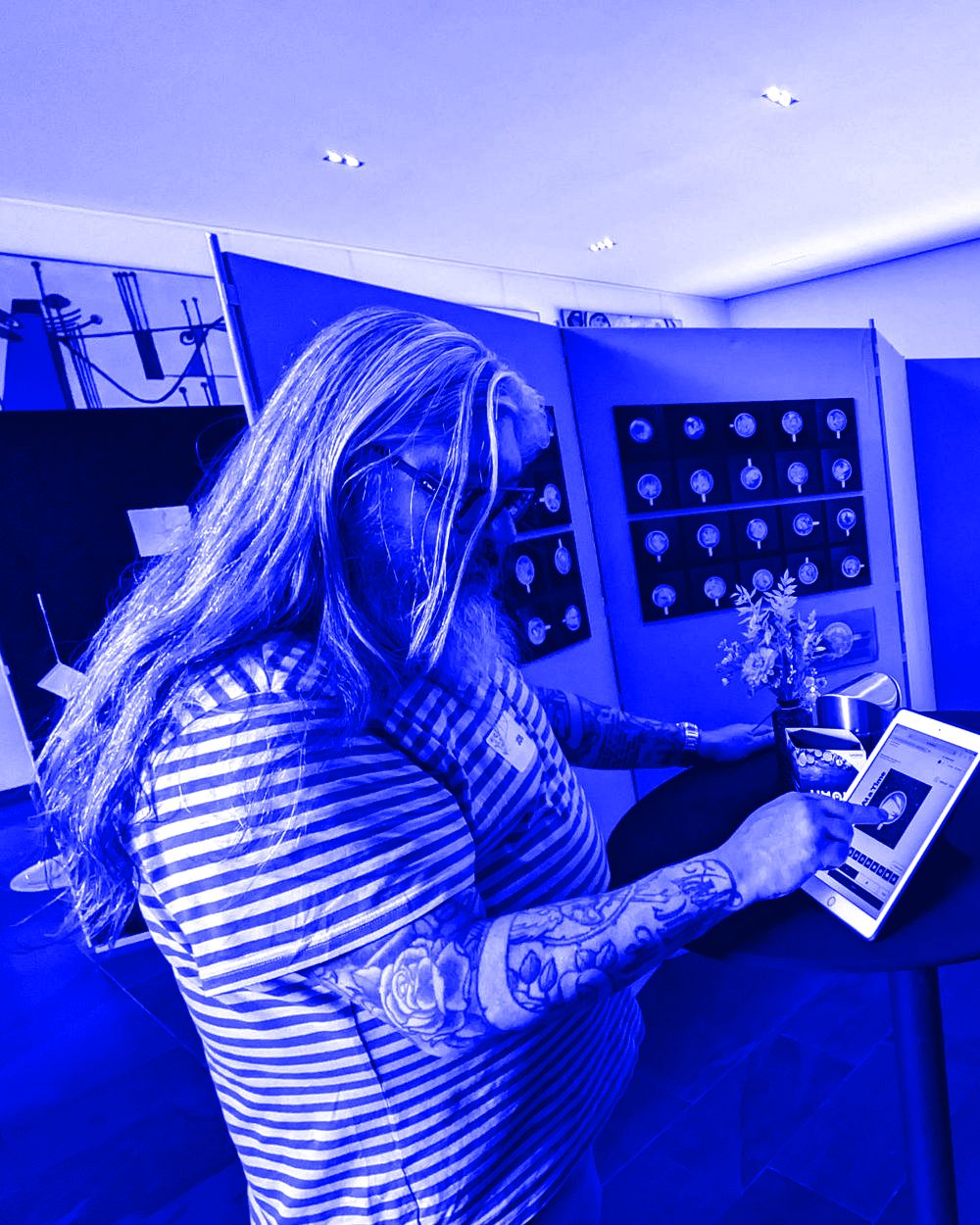
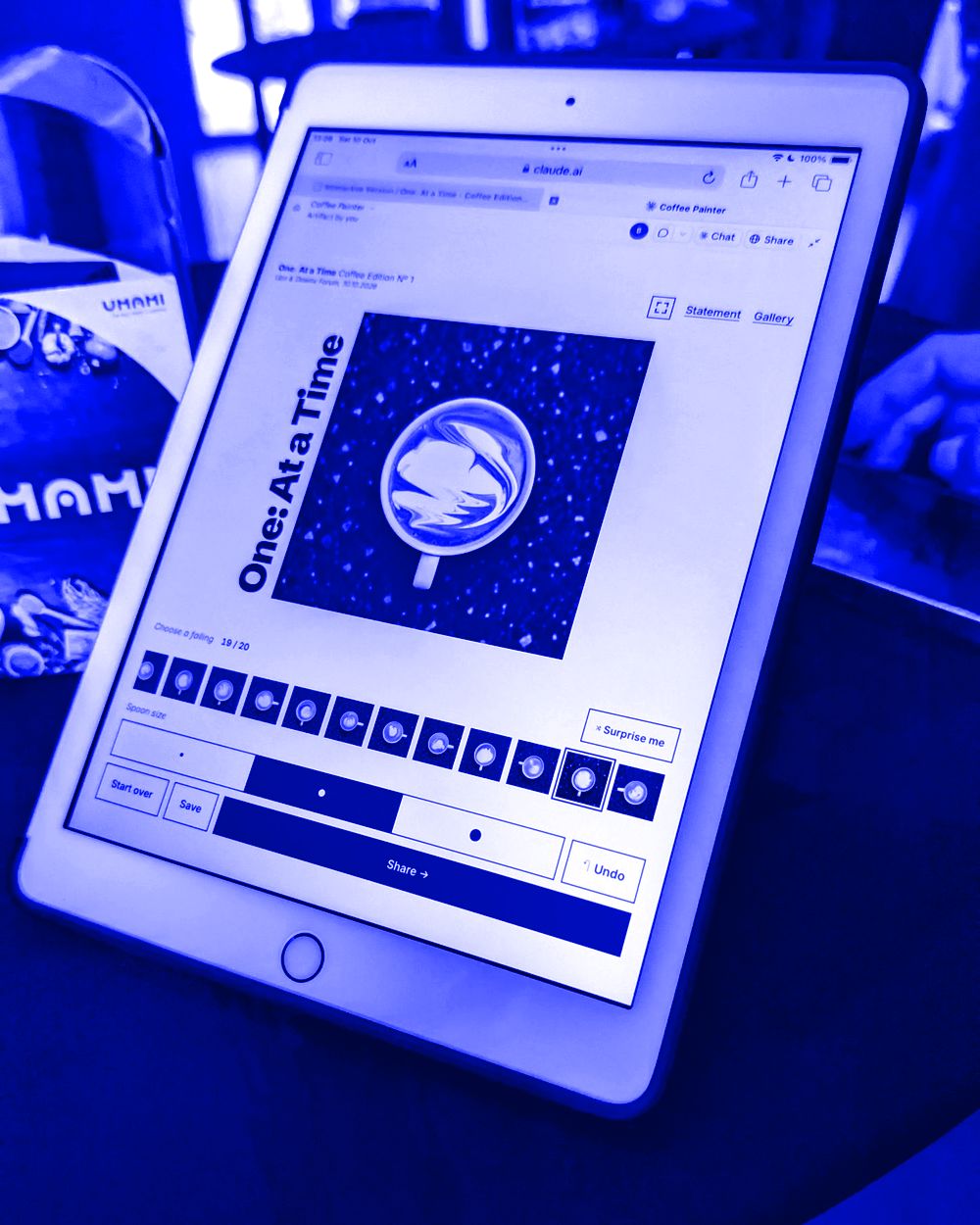
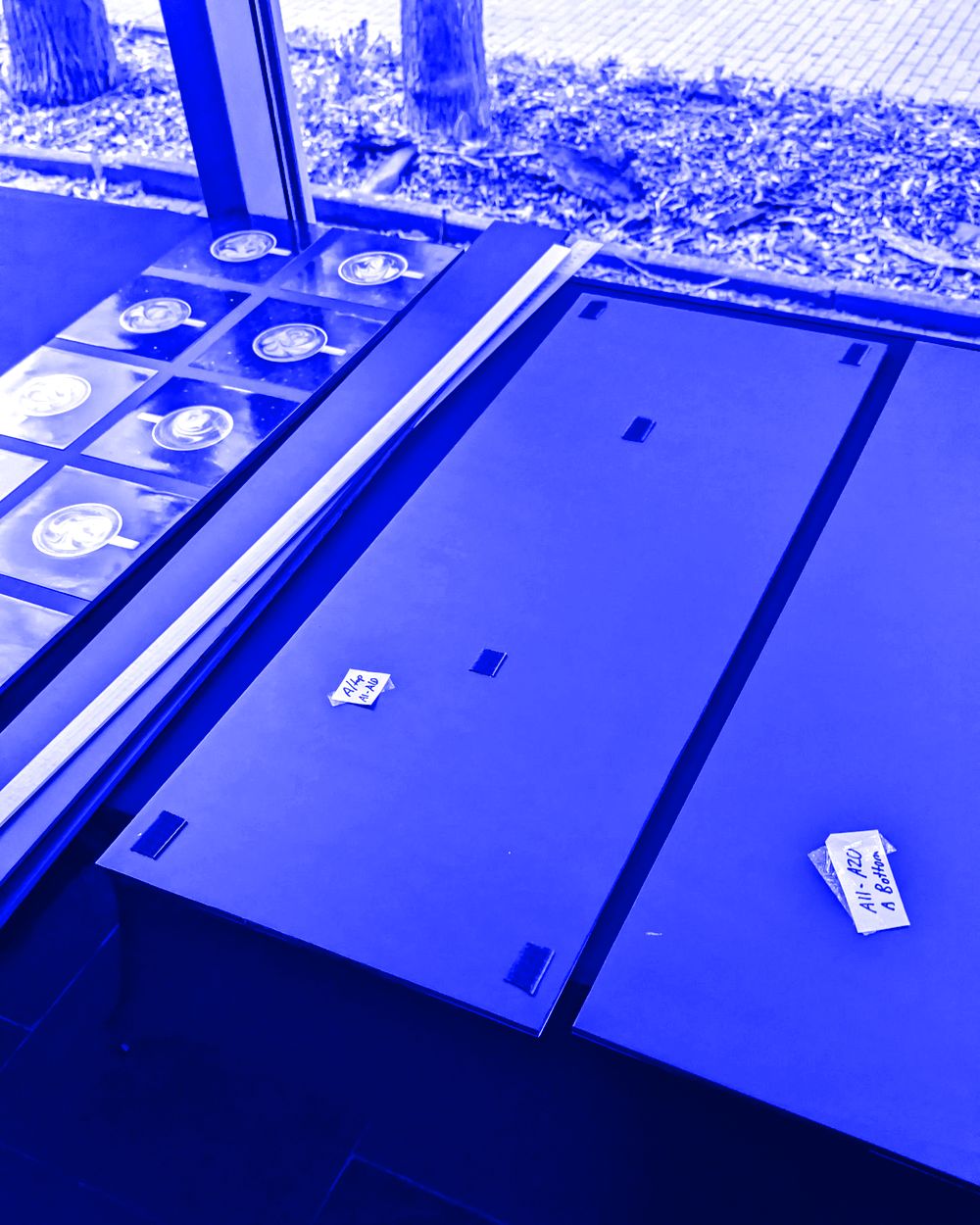
Co for collaboration, collective, collection. Corner for any place where we put our heads together. Visitors took one of my coffee failings and turned it into their own painting on an iPad, with their finger as the teaspoon.
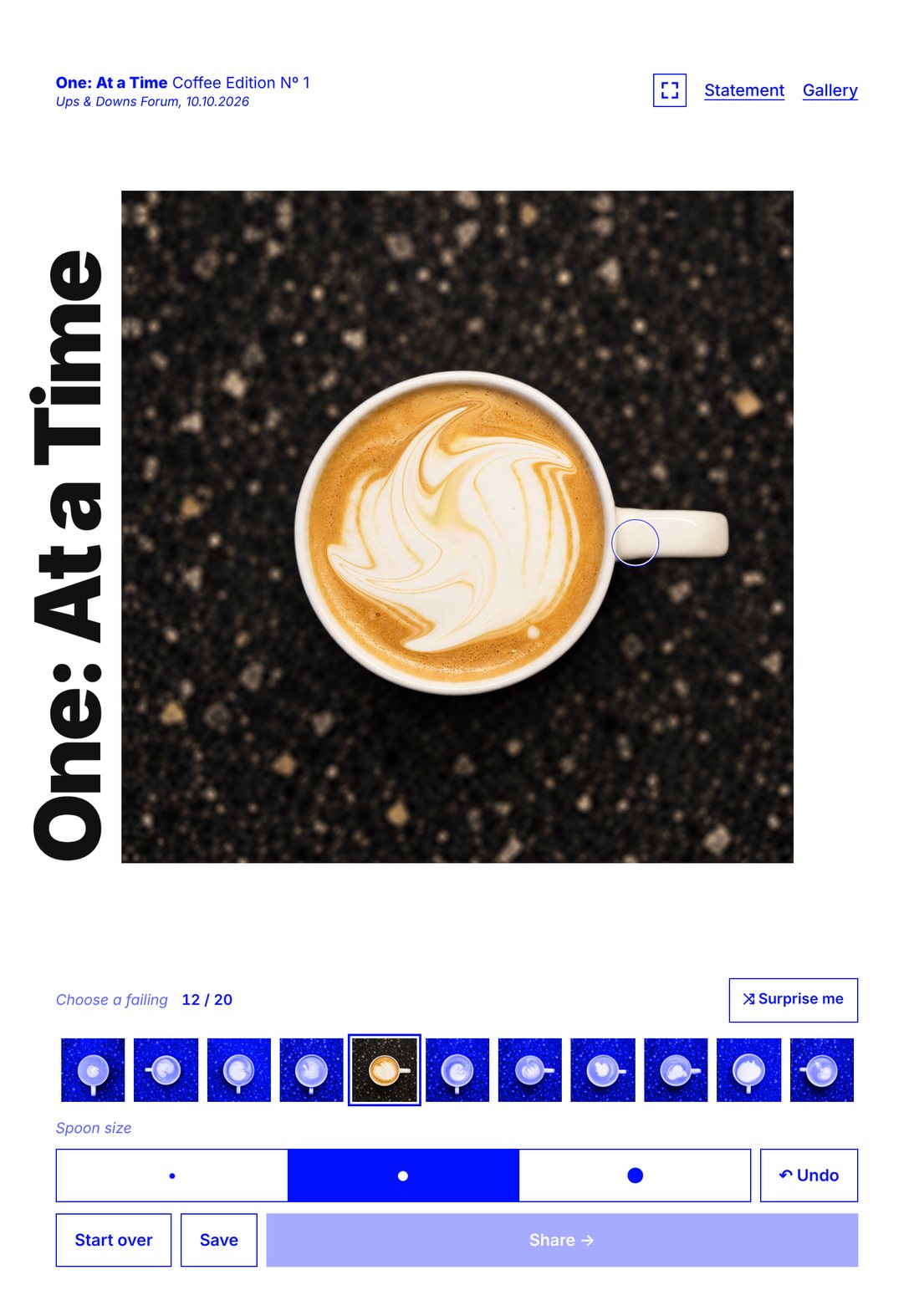
Twenty real failed pours, each one photographed on the same counter.
Three spoon sizes. Undo and Start over make mistakes cheap, which is the whole point.
Email it to yourself with the statement attached, or add it to the visitors’ gallery.
Eight of the visitors’ paintings from the day, as the shared gallery showed them.
Failures are only big in our own minds. They lose their importance as you make play out of them.
Given the tools and a chance, strangers made paintings that were funny, playful and full of ideas. Together they had more creativity than one person alone.
A few people said they weren’t artsy. Most made a painting in a few moves. The label kept the others from trying.
Breaking my solo creative shell and inviting people in as artists blurred our roles. That gesture itself became part of the artwork.
I know myself to be a reserved, closed-up person when it comes to any creative activity. I seek a space of my own, a sort of shell, like a turtle’s, where I can be myself, or rather my creative self. That creative self is delicate and unsure, or completely confident and daring, depending on which stage of the creative process she is in. It often starts with a lot of mistakes, failures and attempts: the part where you don’t get it right in one go. And then you slowly witness something emerging: a visual language, a common essence, a hard-to-describe unity, slowly becoming, dare I say, an artwork. This second bit is just like riding a wave and feeling in complete flow with the water, the earth, the universe, you name it.
It is the scarier first part, those initial and further attempts of trying and mostly failing, that makes a secluded chamber feel necessary. Either we carry it in us as a social species, or it is an individual conditioning: failures aren’t supposed to be out there; making mistakes visible, opening your creative process to the outside world, is a no-go. This is how I have felt so far. Both as a designer and as an artist, I always felt that including others in the process was a threat. An open-plan office is a nightmare for a designer, and the very idea of showing my essays to other experts before publication seems like a strange offer from another universe. Why? Somehow I believe creativity is a one-person chamber, and no one should be allowed in. But is that really so? Or is the chamber perhaps needed only for one phase of the process?
The first signs that this argument didn’t feel right appeared when I started working as a design researcher a few years ago. Until then I had worked mostly as a designer, responsible for designing the designs. But as I did more and more user tests at my last job, I became more and more amazed at how creative and insightful most users are. Through those tests it became apparent to me that creativity is not, or does not need to be, a process of solitude. The more we open up to everyone, the more we listen, the more we include, the clearer it becomes that the line between a designer and a non-designer is fuzzy. So I became a co-design advocate in my own way. I tried to include others in my design process, because I knew that they knew, sometimes much better than me.
My lonely shell of creativity got broken in design practice, so why do I think art is any different? I can think of three reasons.
First, intimacy. Maybe art is so personal, so intimate, that a curtain is necessary. Maybe it depends on the artwork itself, whether it can be made into a public activity or not. But everyone has an intimate world of their own, which means they can relate and create if given the chance.
Second, safety. Making mistakes and attempts in public, during that fragile process, can feel unsafe. Yet mistakes are also a shared experience, which means they can be opened up and shared in a common domain.
Third, roles. We set up a dichotomy: I’m an artist, you’re a visitor. I’m an author, you’re a reader. But is that so?
To find out, I decided to run an art experiment. I call it the ‘CoLLAB Corner’: a reference to collaboration, collaborative collection, and anything Co- represents. Corner stands for any point in time and space where we put our heads together and collaborate. Together. “Together?” “Me? Really?” What happened to the sacred space of creation? What happened to the privacy of the artist? Well, the idea is: if co-design is possible and can become really juicy and interesting, why not try it with art, call it co-art, and see how it feels? If you eventually feel creatively larger than yourself, that’s proof that another creative experience is possible. And this whole process of opening my artworks to others may become an artwork of its own. Project CoLLAB.
The first CoLLAB Corner took place yesterday, inside a small exhibition I held for half a day at an event in Leuven. ‘One: At a Time’ was the exhibition; the CoLLAB Corner was the experiment inside it. Its name refers to daily acts of creativity, such as turning one failed latte art into what I call a ‘coffee painting’, or noticing doors, drain caps, hand-drawn typographic numbers, graffiti or paste-ups. In this sense I’m a collector: one gesture at a time, one collection at a time, one collection of collections at a time.
I wanted to share this experience with the visitors. I made an interactive coffee painting simulator and invited visitors to turn a coffee failure, or a clumsy latte pour, into a coffee painting. I collected their paintings in a gallery, ending up with around 15 drawings. Without quite planning it, I had asked strangers to do exactly what I feared most: take a previous failed pour, begin from a visible mistake, and turn it into something else.
To my surprise, owning up to my mistakes, showing them to strangers and making a little game of them was enough to prove that failures are only big in our own minds. They lose their importance as you make play out of them, especially when the game is shared. The visitors, too, were hesitant in the beginning: afraid to make a mistake and new to the interactive tool. But they gradually got the hang of it. Give them a few seconds and they’re good to go.
Lesson one: collective creativity. I got that same feeling in my gut as when I started working intensively on user tests: “Wow, when given the tools and an opportunity, people have a much bigger collective creativity than you could ever have alone!” Their paintings were funny, playful, open, full of good ideas. This was my big eye-opener, or validator.
Lesson two: the labels we give ourselves. A minority of people said it wasn’t their thing; they’re not artsy at all. I understand that. I carry labels like that myself. “Me? Really?” Yet the majority enjoyed playing with the interactive painter and created a painting within 3–4 finger moves, so there’s a good chance the others could have done it too, and enjoyed it. They just didn’t try. This made me think: the way we categorize and label ourselves is probably causing us to miss out on many opportunities and experiences life has to offer. Even if you don’t consider yourself an artsy person, you have playfulness in you, and that playfulness, combined with curiosity and openness, can surprise you in ways you cannot imagine. You, who think art is not for you, might have a deep artist hidden somewhere inside, which will only surface if you try. Give it a shot.
Actually, my designer label has somehow kept me from trying to be an artist, or even considering it. I had this innate drive to think like a designer: to factor in design principles, functionality, usability, and the user, visitor or human who will interact with the creative work. So my training and designer identity kept me away from the artist label. Funnily enough, that very design label might be making me a better artist now, or a creative who can think of art as an experience, with the different dimensions of that experience factored in! So I’m slowly developing an in-between label: neither designer nor artist, or maybe both. An in-between creative.
Lesson three: the social shell. The shell I described at the beginning was not only a creative shell; it was a social one too. And it cracked in the same way. Talking to people and getting them to play with me, even for two minutes, unfolded a social side of me. I was always a reserved child, yet during my design research projects I saw that I deeply enjoy connecting, talking, getting the other person to join the conversation. The toughest and most interesting part of those user tests was talking to very different groups of people, including high-level policy makers with enormous knowledge and power, who swore freely when frustrated and were somehow polite in an unpretentious way. They were my favorite group: hard to grasp, hard to steer, easy to learn from.
Then, 2.5 years ago, I dared to start a peer group and took on the role of moderator. “Me? Really? A facilitator? No, not me, not possible!” Yet it was possible. It has kept going ever since, and participants and the more experienced moderators who supported me in the beginning all said I’m a natural. Blush. So, “yes, me.” The challenge is similar: different personalities, backgrounds and cultures join the conversation, some more introverted, some more extraverted. Including everyone, managing the group dynamic and the individual dynamics: that’s the joy of it. I sometimes wonder whether I’m autistic. If I am, maybe I have learned to read the room along the way.
Yesterday I put it to the test again: how can I get people to play with me, make a little painting, put a little memory out there? It was hard, just like in design and group moderation, yet deeply joyful in the end. How to approach people, how to draw them in, how to explain the project, how to encourage them and help them along? Each question was answered step by step, with every person in their own way, and the effort was worth it when I saw them smile as their work was added to the collective gallery.
As for intimacy: when I asked participants to join the creative process themselves, I was right beside them, mostly watching what they were doing. I saw them break the shell just by deciding to play along. Their works were also gathered in a digital gallery, and they especially enjoyed seeing them there, as part of an effort that was individual yet collective. No one shared any intimate details. But one participant might have had her own intimate room of experimentation: while I was busy with something else, I saw her from a distance, keeping herself busy painting on my iPad, exploring the interactive tool in her own solitude. Another participant noticed a failed pour that looked like an intimate part (that’s why I had jokingly put it there in the first place), took it and made it look like another intimate part, then saved it in the gallery under that part’s name. So they showed me that intimacy is not something to guard from others: it can be shared, and it can also find its own quiet corner within the collective.
As for mistakes: I saw that the visitors didn’t know how to begin at first; the fear of doing something wrong was there. But as I explained the undo and start-over buttons, they dared to step in, into the world of mistakes and attempts. With confidence.
My own biggest mistake of the exhibition became part of the work. Printing 40 photos is a small but big task, and my inexperience and spectacular planning skills resulted in last-minute prints that turned out much bluer than black. As a result, my dark grey kitchen counter with white dots looked like the depths of a blue galaxy. I took that mistake and chose a vivid dark blue as the accent colour for the exhibition’s statement text and for the interface of the interactive simulator, with an option to view the gallery in monochrome blue. A blue mistake gradually taking over the work: a mistake I transformed and am proud of. One participant immediately noticed the blue, which reassured me that taking it and exaggerating it into a conscious detail was the right creative choice. Thank you for noticing and honouring my mistake.
And as for roles, I held a deep-seated, and probably learned, belief that I’m the artist: me and only me. But yesterday, the visitors took on the label of artist during our experiment. I was merely someone who facilitated their creative act, and that became my artistic practice, or role, for the time being: the art of gently luring in strangers, opening the platform to their participation, and being a present, welcoming host. An enabler, in a good way.
Do I still need the shell? Of course! I’m shy; I turn into a turtle needing its shell whenever I’m thinking ideas through creatively and making them happen. Please put me in a solitary cell for that purpose, at certain phases of creativity. Without the space of solitude, so many of the world’s artworks, thought pieces and scientific works wouldn’t have been possible.
But only when you connect to the rest of the world in a meaningful way does something special come into being: more eyes on a work, more brains on a topic, more fingers on a painting make life richer. Maybe I’m contradicting myself, but I see both deep solitude and deep connection with a community as conditions for great creativity. What matters is that whatever feels right happens during the creative process, even if that is a shell. Yet the extra act of including others is when something completely different can happen, something larger than an individual.
It could also be that including more people makes things muddy and unclear, which means: the right people at the right time. By the right time, I also mean moments of coincidence. Not everything can be created intentionally, after all; letting go of control is also what keeps the creative process creative. And including other people in the process is the best way to loosen that grip of control, see what comes into being and be surprised.
Something in the almost automatic smile on every participant’s face gave it away: we might get the creative juices flowing alone or in small numbers, but the moment we see we’re part of a bigger group, we get a hit of happiness, because we share a commonality that feels like riding the wave, all together. And that’s what made yesterday feel wonderful. The realisation: “It seems I’m not the only one who enjoys being part of the collective!”
Ideas from art, design, psychology and philosophy that this practice and the essay connect to.
Tap a term to open its definition and further reading.
Pass it on, one at a time.